
Poland 10 Zlotych 2011 Jeremi Przybora and Jerzy Wasowski
€1,000.00
Out of stock
SKU
pl5204ad
pl5204 Poland 10 Zlotych 2011 Y# 802 Jeremi Przybora and Jerzy Wasowski - Silver / Proof
| Catalog No. | Y# 802, N# 88261 |
|---|---|
| Material | Silver |
| Send by Registered Mail | Yes |
| Value | 10 Zlotych |
| Year | 2011 |
A 10 zł silver coin with the image of J. Przybora and J. Wasowski
Obverse:
At the top, on the right hand side, the image of the eagle established as the state emblem of the Republic of Poland. To the right of the eagle an inscription: 10/ZŁ. Below the eagle on the right hand side, the year of issue: 2011. On the left hand side a stylized fragment of musical notation. At the bottom stylized images of: an inverted cylinder, a stick, a flower, a sheet of paper and a fountain pen. Below an inscription: Republic of Poland. On the right hand side, perpendicularly, an inscription, POLAND. Under the eagle, on the right hand side, the symbol of the mint: M / W.
Reverse:
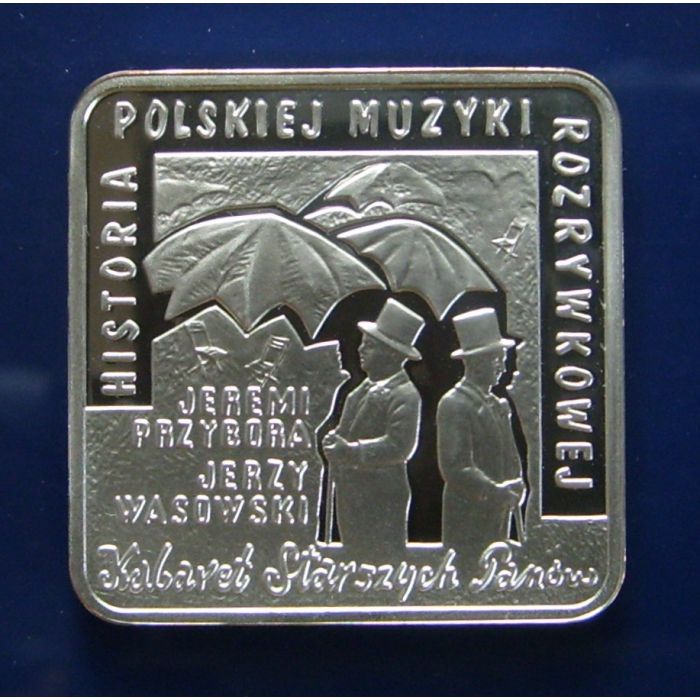
Centrally, a stylized image of an album cover of Kabaret Starszych Panów /the Cabaret of Older Men/, with images of Jeremi Przybora and Jerzy Wasowski. At the bottom, a stylized inscription: Kabaret Starszych Panów. Above an inscription: JERE MI/PRZY BOR A/JERZY /WASOWSKI. At the top, along the edge of the coin from left to right, an inscription: HISTORIA POL SKIEJ MUZYKI ROZRY WKO WEJ /THE HISTORY OF POLISH POPULAR MUSIC/.
Coin designer: Roussanka Nowakowska
Jeremi Przybora
Jeremi Przybora was born on December 12, 1915 in Warsaw. He attended secondary schools in Bydgoszcz and Warsaw, and later on ,without conviction, he studied at several faculties. As a student, he won a contest for "the speaker" of the Polish Radio. He remained on air until the capitulation of Warsaw and the closing of the radio station. He returned to the Polish Radio for the time of the Warsaw Uprising.
In 1948 he returned to Warsaw. The radio theater Eterek , which was established this year, for the next 10 years illuminated the darkness of Stalinism and the Khrushchev Thaw for the audience with funny texts by Przybora with music by Jerzy Wasowski, an engineer and mathematician whom Przybora had met after many years. He soon turned out to be a great actor and composer.
In the wonderful cast of Eterka, alongside Adam Mularczyk and Tadeusz Fijewski appeared Irena Kwiatkowska, since 1958 a powerful (spiritually), but not the only actor pillar of a new television program under the title Kabaret Starszych Panów. The title was a bit misleading - the new program was really a musical theater of absurd.
In 1981, his professional life ended for a long time, and Wasowski's death in 1984, interrupted this unusual friendship between the two artists. Magda Umer has restored his work for new generations in the late 80s, with a series of stories for the television "Cztery pory roku" and a theatrical spectacle "Zimy żal" with songs by Wasowski and Przybora. The song sung by young actors proved to be immortal standards to which auditors are still coming back.
Jeremi Przybora sometimes appeared on television, he released the "almost all" songs in the form of poetry collection (honored with the delight of at least two great writers: "... the biggest Polish poet-humorist ...") and he wrote the three-volume Memoires: Przymknięte oko Opaczności I and II, Zdążyć z happy endem. He also managed to write a musical for children based on the novel by J.M. Barrie to the music of Janusz Stokłosa. The singing of Wendy and Peter Pan was, however, a swan song of a librettist - Jeremi Przybora died on March 4, 2004
Jerzy Wasowski
Jerzy Ryszard Wasowski was born on May 31, 1913 in Warsaw. After graduating from the electromechanical department of the Warsaw University of Technology he began a training in the Polish Radio, working in the following departments: control room, recordings and broadcasts. Just before the war he met Jeremi Przybora on the radio. During the occupation he was in the Zamoyski estate, where he conducted secret education classes in a high school. He gave lectures on science subjects and taught music and drawing. He was an excellent draftsman, he had graphical capabilities (what you can easily see when looking at his music notes), was a keen do-it-yourselfer - until this day different furniture of his authorship is in his house. He liked and knew how to teach, when he returned to the radio after the war, he ran courses for mixers.
After the war (1945-46) he worked in the radio (as an announcer and in technical departments), then in the Miejskie Teatry Dramatyczne /the Municipal Dramatic Theaters/ in Warsaw (1946-1948), initially as a taper then as an actor, until finally - a composer. He was involved in the Polish Radio from 1948 to 1979 - as the head director of music and recordings, the principal director of sound (he developed the script of sound engineering principles for mixers), Deputy Head of broadcasting, director and senior editor of Teatr Humoru i Satyry /the Theatre of Humor and Satire/ (1962 to 1973 .) At the same time, he constantly worked as a teacher, actor and director. In the area of music, he was a self-taught man. He wrote in the tonal system, in different textures: chamber, jazz, symphonic music. An excellent pianist with constant hobbies: mathematics (group theory), and musical acoustics (sound structures).
He composed about 700 songs, 150 music illustrations for radio plays, television shows, movies, cartoons and feature films and plays and about 100 songs for kids (works esteemed the most by the composer himself).
His screen characters are unforgettable: Boleslaw Prus (Telepatrzydło Pana Prusa), the prince bishop in "Ja gorę!", 10 characters in the radio play "Niech żyje człowiek" (distinction at the Prix Italia 1957).