
Poland 10 Zlotych 2013 100th Anniversary of the Polish Theatre in Warsaw
€1,000.00
Out of stock
SKU
pl5218ad
pl5218 Poland 10 Zlotych 2013 Y# 853 Centenary of the Polish Theatre in Warsaw
| Catalog No. | Y# 853, N# 42611 |
|---|---|
| Material | Silver |
| Send by Registered Mail | Yes |
| Value | 10 Zlotych |
| Year | 2013 |
Centenary of the Polish Theatre in Warsaw
Obverse: At the centre, a stylised image of a bas-relief of Irydion that decorates the facade of the building of Teatr Polski in Warsaw. Against that background, at the bottom, an image of the Eagle established as the state emblem of the Republic of Poland. On the sides of the bas-relief image, an inscription: 10-ZŁ [PLN 10]. At the top, in a semicircle, an inscription: RZECZPOSPOLITA POLSKA 2013 [REPUBLIC OF POLAND 2013]. Under the Eagle, a structure made up of a stylised decorative element of the window frame on the building a fragment of a balcony balustrade. Under elevation and the letters ZŁ, the Mint’s mark: M/W.
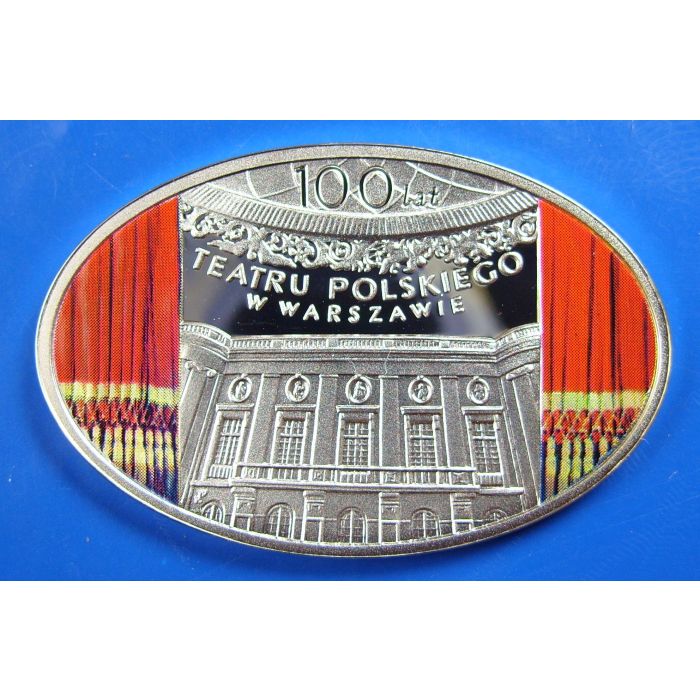
Reverse: In the centre, a stylised image of a fragment of the front part of the building of Teatr Polski in Warsaw. Above, against the background of a stylised fragment of a decorated plafond and on a separate panel, an inscription: 100 lat/TEATRU POLSKIEGO/W WARSZAWIE (100 YEARS/OF THE POLISH THEATRE/IN WARSAW). On the sides, stylised fragments of a theatre curtain.
Teatr Polski in Warsaw is one of the most important theatres in Poland. In 2013, Teatr Polski in Warsaw celebrates its 100th anniversary.
The theatre was opened on 29 January 1913 with the premiere of “Irydion” by Zygmunt Krasiński. Against the odds of the crisis, unfavourable political situation and disapproval of the Warsaw theatre community, Arnold Szyfman, holder of a PhD in philosophy, a beginner playwright with almost no experience and grand dreams of a modern dramatic theatre, managed to convince representatives of the elite to follow his bold idea.
The building, designed by architect Czesław Przybylski, was built in less than nine months. It was one of the largest and most beautiful theatre buildings in Warsaw. Its equipment was very modern: an auditorium with 1,000 seats, a revolving stage, a mechanical fl yloft and a panoramic drop, which provided unprecedented production possibilities.
Subsequent directors of Teatr Polski in Warsaw consequently aimed at creating a distinguished individual style of Polish theatre art. With Szyfman as the director, Teatr Polski in Warsaw gained the status of the best theatre in Poland. It set the standards of contemporary theatre art and the national style. Teatr Polski attracted particular interest again when Kazimierz Dejmek became its director. He turned out a reformer measuring up to Szyfman. Dejmek became the director in 1981 and ran the theatre for 14 years. At that time, the theatre once again became a part of the great history of European theatre.
Since January 2011, the theatre’s general director has been Andrzej Seweryn. Drawing on his 20-years’ experience in Comédie-Française, he introduces Teatr Polski to the new century.