
Poland 10 Zlotych 2012 Boleslaw Prus
€1,000.00
Out of stock
SKU
pl5217ad
pl5217 Poland 10 Zlotych 2012 Y#839 Boleslaw Prus - Silver / Proof
| Catalog No. | Y# 839, N# 64503 |
|---|---|
| Material | Silver |
| Send by Registered Mail | Yes |
| Value | 10 Zlotych |
| Year | 2012 |
Bolesław Prus
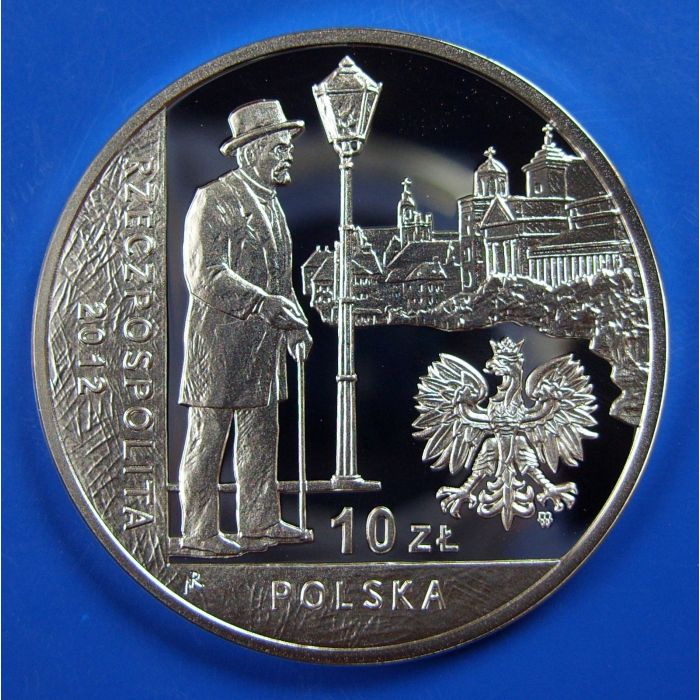
Obverse: On the left, in a separate surface, starting from the top to the bottom, an inscription: RZECZPOSPOLITA [the Republic of]/2012. To the right of the inscription a stylised image of a silhouette of Bolesław Prus walking the street. On the right, in the upper half of the coin, in the background, stylised outline of the Old City in Warsaw, and in the lower part of the coin, an image of the Eagle established as the state emblem of the Republic of Poland. At the bottom, in a separate surface, an inscription POLSKA [Poland]. Above, in the middle, an inscription: 10 ZŁ. Below the Eagle, on the right, the Mint mark: M/W.
Reverse: Centrally, a stylised image of a bust of Bolesław Prus. On the left, against the background of a separate surface, a stylised image of a 19-century lady with an umbrella, against the outline of the Old City in Warsaw. At the bottom, in a semicircle, an inscription: 1847-1912. At the top, in a semicircle, an inscription: BOLESŁAW/PRUS.
Boleslaw Prus, born Aleksander Głowacki (born on 20 August 1847 in Hrubieszów, died on 19 May 1912 in Warsaw) is one of the leading figures in the Polish literary realism of the second half of the 19th century. He grew up in the Lublin region, but his adult life and work were associated with Warsaw. In 1863, Głowacki – then a 16-year-old high school student from Kielce – joined the January Uprising. In 1866, he matriculated in the Department of Mathematics and Physics at the Main School in Warsaw. Later, he studied at the Department of Forestry at the Institute of Rural Husbandry and Forestry in Puławy for a short time, from where in 1870 he came back to Warsaw for a permanent stay. In 1872, he embarked on a career as a journalist. Soon after, he adopted his pen name of Bolesław Prus (derived from the name of the coat of arms of the Głowacki family). In 1874, he began working for „Kurier Warszawski” (Warsaw Courier), starting to contribute regular columns from the following year.
Since the mid-1870s, Prus took up literature as a profession. His prose drew inspiration from the great figures of the European literary realism, yet from the inception of his career the writer sought his own way to realism.
His novels depict the story of a Pole who must contend with his own psyche and the circumstances of the times in which he lived.