
Poland 10 Zlotych 2011 Polish Cavalry, Ulan of the Second Republic - Silver
€39.00
In stock
SKU
pl5198
pl5198
Poland 10 Zlotych 2011 Polish Cavalry, Ulan of the Second Republic - Silver / Proof
y# 781, N# 88272
| Catalog No. | y# 781, N# 88272 |
|---|---|
| Material | Silver |
| Send by Registered Mail | Yes |
| Type | Military |
| Value | 10 Zlotych |
| Year | 2011 |
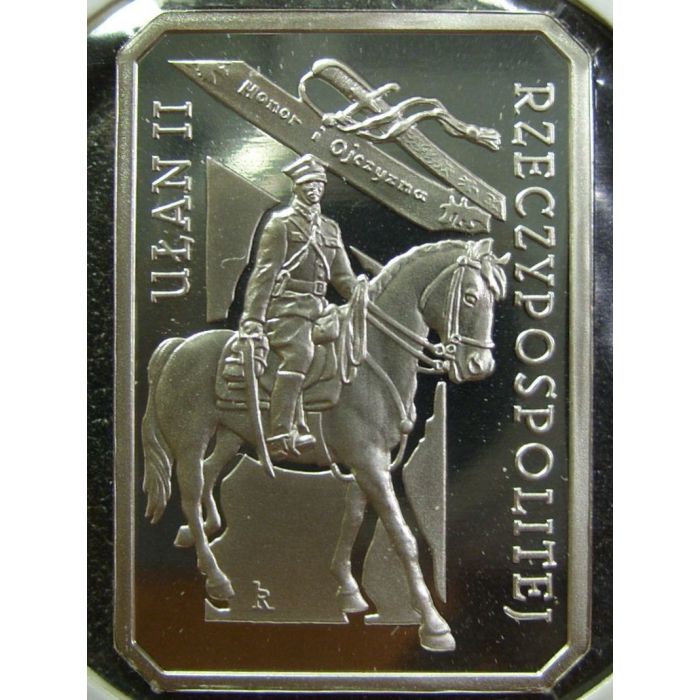
A silver commemorative 10-zloty coin with an image of anuhlan of the Second Polish Republic from the History of the Polish Cavalry series.
Obverse:
Along the left rim of the coin an inscription: RZECZPOSPOLITA (THE REPUBLIC). Along the upper rim of the coin an inscription: POLSKA (OF POLAND). On the right-hand side, in the upper part, an inscription: 10/ZŁ. In the center, against the background of the contours of stylized images of horses, an image of the eagle established as the state emblem of the Republic of Poland. Below the eagle stylized images of weaponry elements and equipage of an uhlan: lance, sabre, rifle and saddle. Below the year of issue: 2011. Under the eagle’s left foot the symbol of the mint: M/W.
Reverse:
Along the left rim of the coin, in the upper part, an inscription: UŁAN II (UHLAN OF THE SECOND). Along the right rim of the coin an inscription: (POLISH REPUBLIC). In the center, a stylized image of an uhlan holding a sabre on horseback. Above stylized images of: a sabre fragment with an inscription: “Honour and the Homeland” and a fragment of a sabre with a hilt.
Coin designer: Robert Kotowicz
In the armed forces of the Second Polish Republic, the cavalry was, alongside the infantry and the artillery, one of the three kinds of military units.
Its beginnings are related to the rebirth of the Polish state in the autumn of 1918. The first cavalry units were formed on the basis of Polish units fighting in the fronts of the First World War. Formally, the cavalry was divided into regiments of the uhlans, the chevau-légers (being a reference to the tradition of the Polish Legions) and the mounted rifles. In the years 1918–1921, the cavalry took an active part in the battles for establishing the boundaries of the Polish state. During the Polish–Soviet War, it could boast many successes, e.g. on 31 August 1920 near Komarów, in the last great cavalry battle in the world history of the armed forces, it defeated the units of the First Cavalry Army of Semyon Budyonny.
The cavalry was an armed force which moved on horseback, but fought dismounted. The horse was only a means of communication – in the interwar Poland the automotive industry was only beginning to develop and the roads were in a bad condition. The basic weaponry of a cavalryman was a rifle and a sabre. During more official appearances the uhlans were equipped with lances with pennants in the colours of their unit. Although they were trained in fighting with a lance, they were not expected to use this weapon in battle. The sabre, a real symbolic weapon of a Polish uhlan, also had little battle significance, although works on its improvement were conducted. As a result, in 1934 the last scientifically developed sabre was introduced to the weaponry of a cavalryman, produced in the Ludwików steel mill. Apart from individual weaponry, the cavalry had machine guns, anti-tank rifles, mortars and artillery. In battle, they were to be supported by armoured cars.
At the time of the Second World War, the cavalry was an obsolete armed force. For this reason the motorisation of the units was undertaken. The first unit to be reformed was the 10th Brigade of the Cavalry which was subordinated to the commander of the Armoured Forces.
In September, the Polish uhlans could quickly and effectively move during fights with the enemy. They fought with rifles and machine guns, using horses as a means of transport. However, a few cavalry charges against the German troops took place, e.g. near Krojanty, Węglowa and Krasnobród.