
Poland 20 Zlotych 2011 Zofia Stryjenska / Horseback scene - Silver
€78.00
In stock
SKU
pl6079
pl6079
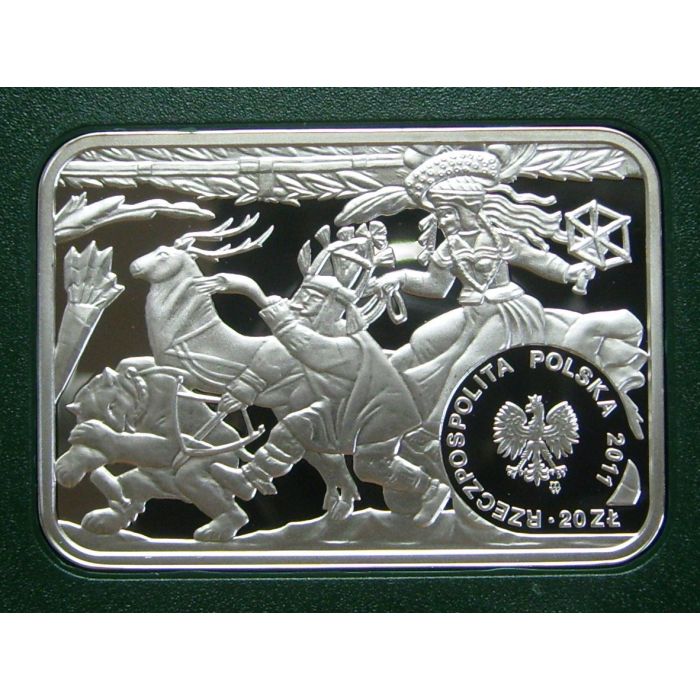
Poland 20 Zlotych 2011 - Zofia Stryjenska / Horseback scene - Proof / Silver
Y# 765, N# 51905
| Catalog No. | Y# 765, N# 51905 |
|---|---|
| Material | Silver |
| Send by Registered Mail | Yes |
| Type | Art |
| Value | 20 Zlotych |
| Year | 2011 |
A silver collector coin struck using the pad printing technique from the series dedicated to the most prominent painters of the 19th and 20th centuries.
Obverse:
Stylised image of part of a painting by Zofia Stryjeńska. At the bottom on the right, image of the Eagle established as the State Emblem of the Republic of Poland. Around the Eagle, at the bottom from right to left, inscription: 20 ZŁ, followed by an interpunct, inscription: RZECZ POSPOL ITA POL SKA (Republic of Poland) and notation of the year of issue: 2011. The Mint’s mark, M/W, under the Eagle’s left leg.
Reverse:
Stylised image of a bust of Zofia Stryjeńska. On the left, facsimile of her signature. At the bottom on the right, stylised image of a palette and three brushes. On the palette, red, yellow, green and blue paints. Above the palette, perpendicularly, inscription: 1891–1976. On the right, stylised fragment of a painting by Zofia Stryjeńska.
In the bottom right corner, inscription: ZOFIA and, perpendicularly, inscription: STRYJEŃSKA.
Coin designer: Urszula Walerzak
Zofia Stryjeńska, nee Lubańska (1891–1976), was educated in private art schools in her home town, Cracow, and in the Academy of Fine Arts in Munich. Her debut, signed with her family name, was an exhibition in 1912 of her illustrations of Polish fables based on folk tales. A year later she created a cycle of watercolors on the theme of Polish Christmas carols, and during the I World War – postcards with illustrations of nativity plays and legion songs.
The gained recognition and popularity already for her early paintings – the “Hunting Gods” and “Passover cycles”, as well as the works from 1923 – “Dawn”, “Dusk” and “Beriot Concert”. The decorative panneaux “Seasons”, presented along with other works of Stryjeńska at the International Exhibition of Modern Decorative and Industrial Arts in Paris in 1925, won her four grand prix and two honorary diplomas. The artist also designed decorations for other interiors (e.g. “Fire and Water” for the office of the Polish diplomatic mission in Sofia) and polychrome decorations of several tenements in the Warsaw Old Town (1928). She published two folders of color lithographs “Slavic Idols” and illustrated several dozens of books. She designed posters, advertising materials and toys. She also created set designs, wrote screenplays for musical performances and in 1928 designed the entire visual setting for the ballet “Harnasie” of Karol Szymanowski.
The diversity of projects in which Stryjeńska was involved demonstrates her almost unlimited artistic potential and the power of her talent. Adjusting the language of plastic arts to the characteristics of each project, she always left in her works a mark of her individual style. Simplified forms, juxtaposed in dynamic and rhythmical combinations of intense colors, tightly fill the cadres of all her compositions. The link between Stryjeńska’s works and folk culture lies not only in the themes and motives found in ethnographical sources and processed by the artist in her own distinctive way, but also in the sensuous impetuousness which is both the content of presented scenes and the dominant feature of their artistic design. She freely played with the figures of Slavic gods and the Piast dynasty, placing the legendary founder of the dynasty as if behind a wheel of a car and putting a cigarette in the hand of Casimir the Great.
An exquisite intelligence of the artist, her exceptional sense of humor and at the same time a simple, critical self-assessment of her works are confirmed by Stryjeńska’s memoirs published in 1995 under the title “Bread Almost Daily” (“Chleb prawie że powszedni”).