
Poland 20 Zlotych 2010 "Battle" Arthur Grottger - Silver
€77.00
In stock
SKU
pl6085
pl6085
Poland 20 Zlotych 2010 Arthur Grottger - Silver
Y# 747, N# 51904
| Catalog No. | Y# 747, N# 51904 |
|---|---|
| Material | Silver |
| Send by Registered Mail | Yes |
| Value | 20 Zlotych |
| Year | 2010 |
Obverse:
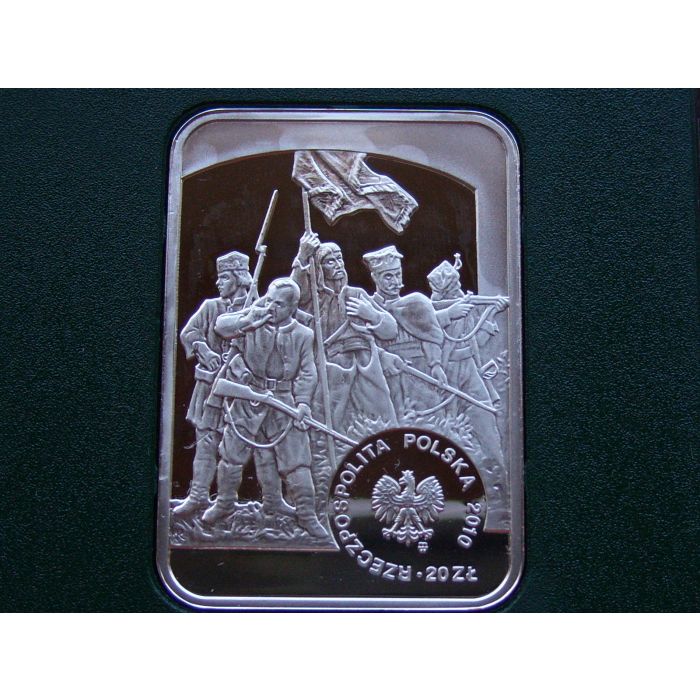
The centrally stylized image of the fragment of the Artur Grottger’s drawing “The Battle” from the “Polonia” cycle. At the right bottom side, an image of an eagle established as the national emblem of the Republic of Poland. Around the eagle, an inscription: 20 ZŁ (PLN 20) and after a separating dot, an inscription: RZECZPOSPOLITA POLSKA (THE REPUBLIC OF POLAND) and the emission date: 2010. Under the left eagle’s foot a symbol of the mint. M/W
Artur Grottger was born on November 11, 1937 in Ottyniowice, in the estate leased by his father, who was a painter too and who gave him the first pieces of advice. After studies under the apprenticeships of Lvov masters in painting, Grottger attended Krakow and Vienna academies. In Vienna he cooperated with some of the magazines as an illustrator. In 1865 he returned to Lvov where he soon met only sixteen-year-old Wanda Monné he got engaged with. This feeling changed the artist and influenced his works.
The earliest Grottger’s works presented historical scenes, mostly battles, frequently with motives of riders. Later, when he lived in Vienna, the artist created press illustrations and also undertook works related to the theatre and derived from literature. He also came back to historical episodes and during holiday trips to the country he painted horses. His output includes also works of a symbolic nature and numerous portraits, including images of her fiancée and himself. Many paintings created after 1863 refer to the January Uprising events and its tragic epilogue taking place in Siberia.
The first of the five drawing cycles, which are still associated the most with Grottger’s works, was created in Vienna, within several days, as a direct reaction to events in Warsaw in 1861, which the artist found out from press reports. The cycle called Warsaw I had its continuation in form of the next seven cards which were created a year after and marked with the same title and the number II. The following two cycles Polonia (1863) and Lituania (1864-1865) were devoted to the January Uprising, and the last, the largest one completed in Paris in 1867 was titled the Battle. This cycle has got universal significance as it depicts disaster and moral decay which follow every large armed conflict.
Grottger’s language of illustration, joining realism of details and idealization of characters with emotionally rich significance of a whole proved to be communicative and exceptionally suggestive. Thanks to it, the cards had an influence on other works of art, including literary ones of, among others, Maria Konopnicka and Stefan Żeromski.
The person of Artur Grottger as well as his works started to pass into legend with time especially after publishing thorough biographies and correspondence of the artist. He died at young age, struggling with tuberculosis and ceaseless financial problems, gifted and inspired but not appreciated – Grottger, with his life history, perfectly fitted into the romantic artist myth.