
Poland 2 Zlote 2008 - Ann. Warsaw Uprising
€1.99
In stock
SKU
pl2699
pl2699 Poland 2 Zlote 2008 Y# 633 - Ann. Warsaw Uprising
| Catalog No. | Y# 633, N# 9600 |
|---|---|
| Material | Brass |
| Send by Registered Mail | No |
| Value | 2 Zlote |
| Year | 2008 |
The Warsaw ghetto uprising was the first urban armed response against the nazis in the occupied Europe. The Warsaw ghetto was the largest forcibly created dwelling place for Jews. From the spring of 1940 the Germans started to surround the area in the centre of Warsaw that they set to be occupied by Jews by a three metre-high wall. The ghetto was separated from the rest of the city and finally sealed off on 16 November 1940. More than 360 thousand people were squeezed on an area of 307 ha – 1/3 of the inhabitants of the whole city living on 2,5% of its total area. With people being resettled from other towns, the number of people imprisoned in the ghetto increased to over 450 thousand, to gradually decrease as a result of 96 thousand people dying from hunger and diseases. In the summer of 1942 the Germans took away and murdered in the gas chambers of Treblinka nearly 300 thousand people. 55 thousand remained in the ghetto, mostly young people without a family. Some of them decided to fight. Zionist and youth organizations along with the socialist Bund created in the ghetto the Jewish Combat Organization (Żydowska Organizacja Bojowa, ŻOB). In the night of 18 April all the troops of the ghetto took their positions. The German troops entered the ghetto in the early morning of 19 April. Their aim was to murder the remaining inhabitants of the ghetto. As a result of the first operation led by Colonel von Sammern several Germans were killed and wounded. Still on the same day the lead was taken over by an SS and police general Juergen Stroop. The German forces, including the SS, police, army and Ukrainian troops, counted as many as 2054 soldiers and 36 officers equipped with armoured vehicles, tanks, guns, flame-throwers, anti-aircraft guns and heavy machine guns. Their opponents were 500 poorly armed ŻOB combatants and about 250 ŻZW combatants, as well as an unknown number of smaller informal groups. In the course of the first days of fighting solidarity actions on the part of the People's Guard (Gwardia Ludowa) and the Home Army (Armia Krajowa) took place on the other side of the wall. The actions occupied some of the German forces, but they did not have any real impact on the fights within the ghetto. After a few days the Germans began to systematically burn and demolish houses. The combatants had to move to underground shelters. On 8 May the Germans managed to locate a shelter at 18 Miła Street, where ŻOB had its headquarters and where stayed about 100 combatants and about 200 civilians. Most of them died as a result of gas poisoning. Some combatants committed suicide. One of the dead was the leader of the uprising, Mordechaj Anielewicz. Only few managed to hide and then escape. From 19 April to 15 May the Germans took away approximately 50 thousand of the captured Jews. The official death toll on the German side was 86 dead and 420 wounded. On 16 May 1943, as a symbol of the final defeat of the ghetto, Stroop blew up the Great Synagogue of Warsaw in Tłomackie street (today the site is occupied by the Blue Tower Plaza building in Plac Bankowy). However, some fights in the ghetto continued until June.
Obverse:
The image of the eagle established as a state emblem of the Republic of Poland. The notation of the date of issue, 20-08, is located at the sides of the eagle. Under the eagle there is an inscription: ZŁ 2 ZŁ, and the inscription RZECZPOSPOLITA POLSKA in the rim with six pearls on each side of the inscription. There is a mint mark under the eagle’s left leg.
Reverse:
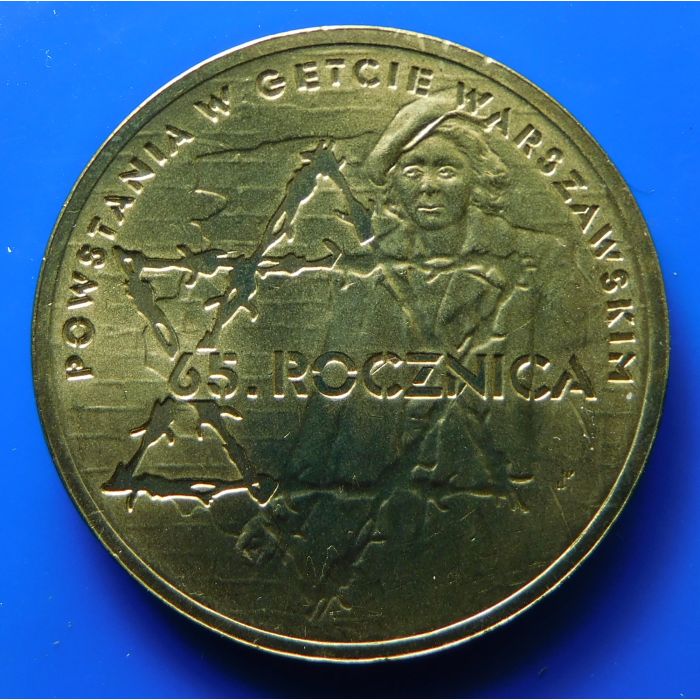
There is an image of a girl on the right-hand side, and a brick wall in the background. There is a central inscription: 65. ROCZNICA against the image of the Star of David composed of a barbed wire. There is a semicircular inscription: POWSTANIA W GETCIE WARSZAWSKIM at the top.
On the edge: The inscription NBP repeated eight times. Every second inscription is inverted 180 degrees and separated with stars.
Obverse designer: Ewa Tyc-Karpińska
Reverse designer: Urszula Walerzak